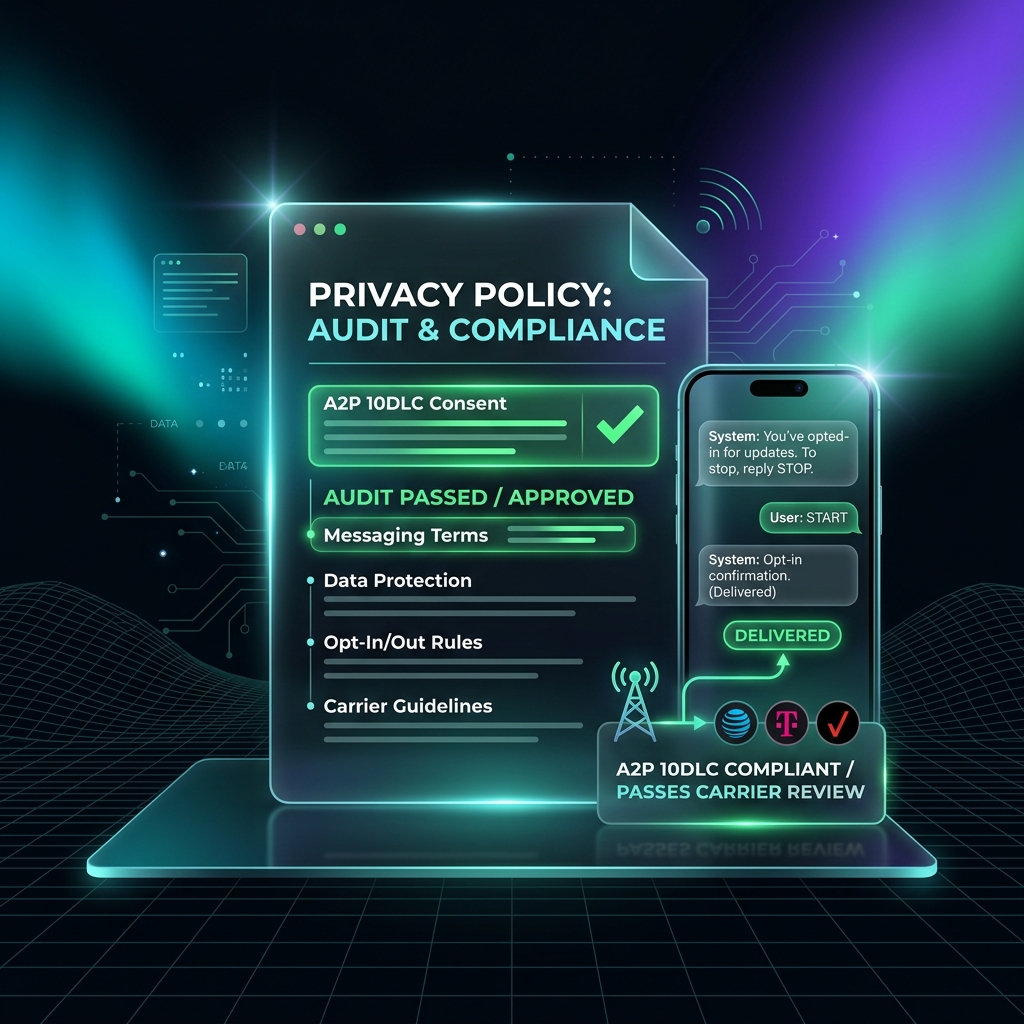
Has your business text messaging campaign been blocked? If you recently submitted an Application-to-Person 10-Digit Long Code (A2P 10DLC) campaign registration through Twilio or another wholesale carrier only to receive a flat rejection, you are not alone. Mobile carriers — AT&T, T-Mobile, and Verizon — have dramatically hardened their auditing rules, and a single missing legal clause on your website will trigger an automatic campaign failure.
The leading cause of A2P 10DLC campaign rejections is a non-compliant website Privacy Policy. Carrier auditors verify every registration by hand, visiting your website to confirm that you explicitly protect customer phone numbers and text messaging consent from third-party sharing.
Resolving this block does not require hiring a compliance attorney. It requires inserting a specific, non-negotiable SMS data-protection clause into your website’s Privacy Policy and updating your contact forms to match carrier opt-in standards.
Why Mobile Carriers Are Rejecting A2P 10DLC Campaigns
Carriers reject A2P 10DLC campaigns to protect their networks from unsolicited spam and phishing. The Campaign Registry (TCR), which audits registrations for the major US carrier networks, treats text messaging consent as completely sacred. Under standard carrier rules, text messaging opt-in consent cannot be bought, sold, rented, or shared with third parties for marketing purposes.
When a carrier auditor evaluates your brand registration, they perform a manual inspection of the website URL you provided in your business profile. If they cannot find a live, publicly accessible Privacy Policy link, or if your policy contains generic data-sharing language, they will instantly reject your registration with the error code: “Carrier Audit Failure: Non-Compliant Privacy Policy.”
To pass this manual audit, your privacy documentation must explicitly state that text messaging opt-in data is isolated and will not be shared with outside entities.
The Core Problem: Missing or Non-Compliant SMS Privacy Language
Most corporate Privacy Policies are drafted using standard, generic online templates. These templates almost always include standard legal text allowing the business to share customer contact information with “affiliates, partners, third-party service providers, and marketing networks” to help deliver services and promotional offers.
To a telecom auditor, this standard legal boilerplate is an immediate rejection trigger. Carriers make no distinction between a premium marketing partner and a malicious SMS spam broker. If your policy says you might share customer phone numbers with affiliates or partners, they assume you will.
Your Privacy Policy must contain a strict carve-out that specifically isolates text messaging opt-in data from all other general sharing practices.
Compliant vs. Non-Compliant Privacy Clauses (The Direct Comparison)
Carriers look for explicit, unambiguous language. To understand how auditors evaluate your legal text, compare these two approaches:
| Clause Element | Non-Compliant (Automatic Rejection) | Compliant (Carrier Approved) |
|---|---|---|
| SMS Sharing Disclosure | “We share contact information, including names and phone numbers, with our affiliates, subsidiaries, and marketing partners to provide you with relevant promotions.” | “No mobile information will be shared with third parties/affiliates for marketing/promotional purposes. All other categories exclude text messaging originator opt-in data and consent; this information will not be shared with any third parties.” |
| Service Provider Sharing | “We may share your data with third-party service providers who assist us in communicating with you.” | “We do not share your text messaging opt-in data or consent with any third-party service providers, except strictly as necessary to route and deliver your text messages.” |
| SMS Opt-In Sources | No mention of how text messaging phone numbers are collected or handled separately. | “Personal data collected for text messaging (including phone numbers, opt-in consent, and message history) is stored securely and isolated from general marketing databases.” |
If your policy reads like the left column, your campaign will be blocked. To pass, you must rewrite your data-sharing disclosures to resemble the right column.
The Copy-Paste A2P 10DLC Compliance Privacy Policy Template
If you need to quickly bring your website into compliance to pass your Twilio audit, you can insert this dedicated SMS Privacy Policy Section directly into your website’s existing Privacy Policy page.
Simply copy the template below, replace the bracketed business placeholder, and publish the page:
CODEBLOCK0
Website Form Requirements to Pass Carrier Audits
A compliant Privacy Policy is only half the battle. Auditors also check the physical forms on your website where users enter their phone numbers (such as your Contact, Quote Request, or Sign-Up forms) to verify how you collect consent.
If you collect phone numbers on your site and intend to send them text messages, your forms must adhere to these five carrier constraints:
- Explicit SMS Disclosure: You must place clear, readable text directly below the phone number field disclosing that by submitting the form, the user agrees to receive SMS messages from your business.
- Links to Legal Documents: The disclosure text must contain clickable, live links pointing directly to your website’s Privacy Policy and Terms of Service.
- Rates Surcharge Warning: You must include the phrase: “Message and data rates may apply. Message frequency varies.”
- No Pre-Checked Checkboxes: If you use a checkbox for SMS opt-in consent, it must be unchecked by default. Forcing a user to manually uncheck a box does not constitute valid opt-in consent under federal TCPA guidelines.
- No Forced Opt-In: You cannot make SMS consent a mandatory field to submit a standard contact form. The user must be allowed to contact your business without being forced to subscribe to text alerts.
Example Compliant Form Disclosure Text:
“By providing your phone number, you agree to receive text messages from Your Business Name]. Message and data rates may apply. Message frequency varies. You can reply STOP at any time to opt out. View our [Privacy Policy and Terms of Service.”
How Blueprint Softphone Streamlines Your SMS Compliance
Decoupling your software frontend from your telecom carrier layer gives you direct control over your compliance registry footprint. Proprietary, bundled VoIP service providers act as a middleman, submitting your brand under their own shared corporate profiles with mixed attestation.
Blueprint Softphone operates differently. It connects your desktop interface directly to your own verified Twilio account, giving you complete ownership of your brand registry. The app handles the complex technical plumbing automatically:
Messaging Service Creation: Blueprint programmatically creates your Twilio Messaging Service and attaches your phone numbers to it.
Compliance Warnings: The app actively monitors your outbound delivery and alerts you in settings if your carrier registration requires attention.
- Direct Registry Control: You register your brand and campaign directly in Twilio, ensuring 100% transparent attestation and avoiding recycled carrier pool blocks.
For a detailed step-by-step walkthrough of the entire registration process in your Twilio Console, review our comprehensive A2P 10DLC compliance guide.
Resolving these compliance blocks is not just about routing messages — it is also about protecting your bottom line. If your campaign gets rejected and your outbound lines are stuck in unverified pools, you continue paying high monthly seat premiums for legacy VoIP platforms. Adopting a direct API model allows you to resolve compliance, secure direct delivery, and eliminate the unlimited VoIP billing illusion to reclaim your telecom budget.
The Bottom Line
A rejected A2P 10DLC campaign is almost always a paperwork problem, not an operational one. Mobile carriers reject brand registrations manually if your website’s Privacy Policy contains generic, template-driven clauses allowing contact sharing with partners or affiliates. To pass a carrier audit, you must insert an explicit “SMS Privacy Clause” that strictly isolates phone numbers and consent from all third-party marketing sharing, ensure your web forms collect consent without pre-checked boxes, and link directly to your legal policies. Decoupling your communications interface and connecting directly to your own wholesale carrier account keeps you in complete, unmediated control of your brand reputation and compliance.
Brent Pope
Founder, Blueprint Softphone · 40+ years enterprise IT
Related Articles
Why Does My Business Number Show “Spam Risk” — And How Do I Fix It?
Your outbound lines show "Spam Risk" because bundled VoIP providers route calls through recycled number pools with weak STIR/SHAKEN attestation. Here's the…

STIR/SHAKEN Attestation Levels Explained: Why Your Calls Show ‘Scam Likely’
Discover how STIR/SHAKEN cryptographic attestation levels (A, B, or C) impact outbound call deliverability and how to ensure your lines receive Level…

Zero-Trust Credential Architecture: Why Your Twilio API Keys Should Never Touch a Server
Is your business phone system exposing your master Twilio credentials? Learn why client-side security and short-lived WebRTC tokens are critical.