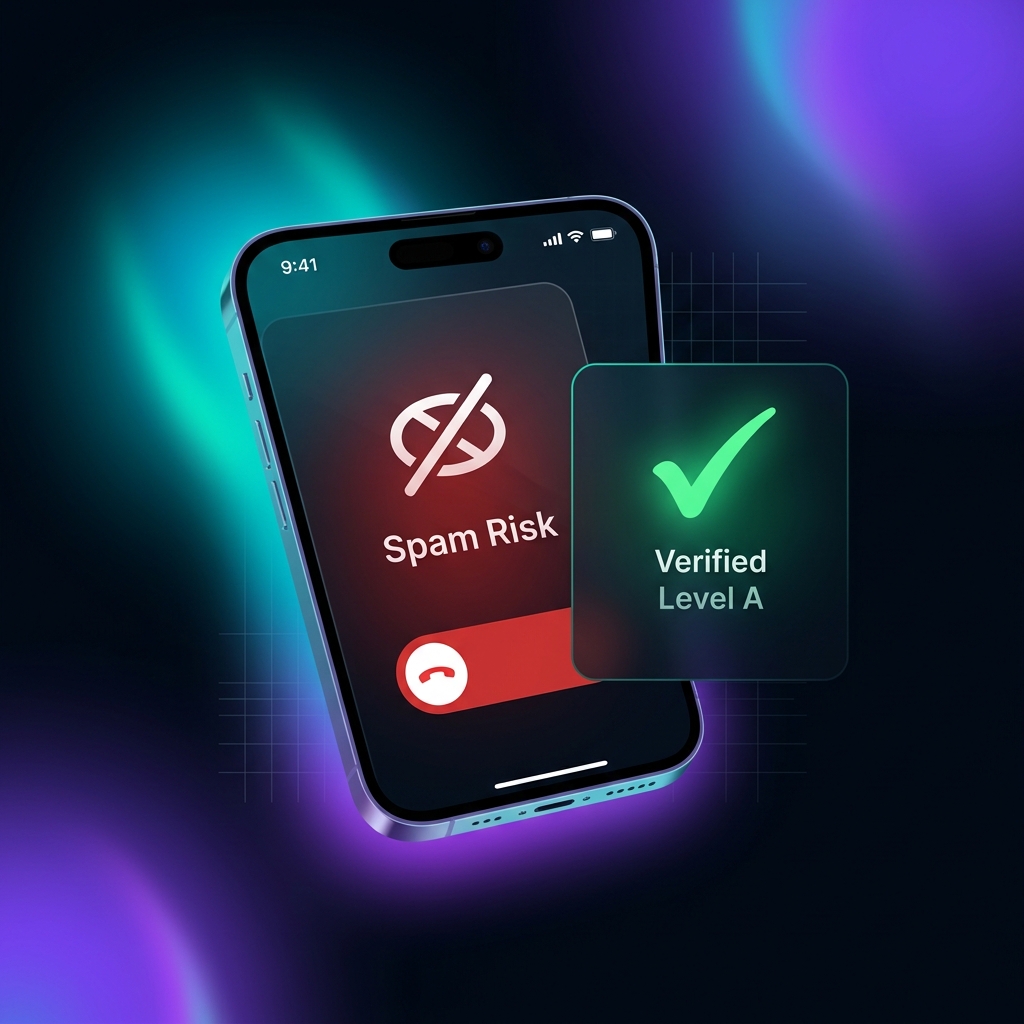
Your business phone number displays “Spam Risk” or “Scam Likely” because the carrier network has flagged it — and the root cause is almost never your calling behavior. It is the telephony infrastructure your VoIP provider uses to route your calls. Bundled, “all-in-one” business phone services dial out through shared, recycled number pools routed via low-tier gateway connections. The downstream analytics engines at AT&T, T-Mobile, and Verizon see those patterns and flag your caller ID before the prospect’s phone even rings.
The permanent fix is not a settings change. It is an architectural change: securing direct, verified carrier-level STIR/SHAKEN attestation on numbers you control.
What Causes the “Spam Risk” Label on Business Phone Numbers?
The “Spam Risk” and “Scam Likely” labels are applied by carrier analytics engines — Hiya (AT&T), First Orion (T-Mobile), and TNS (Verizon) — based on call traffic patterns and cryptographic trust signals. Three factors determine whether your outbound number gets flagged:
- STIR/SHAKEN attestation level — the cryptographic signature your provider attaches to every outgoing call
- Number pool reputation — whether the phone number was previously used by aggressive robocallers
- Calling behavior signals — volume spikes, short-duration calls, high unanswered rates
Of these three, attestation level is the most consequential — and the one most business owners have never heard of.
What Is STIR/SHAKEN and Why Does the Attestation Level Matter?
STIR/SHAKEN (Secure Telephone Identity Revisited / Signature-based Handling of Asserted information using toKENs) is the FCC-mandated framework that digitally signs outbound calls to verify they are not spoofed. Under current FCC rules, every voice service provider must sign call traffic using a Service Provider Code (SPC) token that they directly own — providers are prohibited from using “borrowed” identity credentials.
The critical detail is that STIR/SHAKEN has three attestation levels, and they are not equal:
| Attestation Level | What It Means | Spam Risk Impact |
|---|---|---|
| Level A (Full) | Provider has verified the caller’s identity AND confirmed they are authorized to use the specific number | Lowest risk — carrier analytics engines treat this as a strong trust signal |
| Level B (Partial) | Provider has verified the caller’s identity but cannot confirm authorization to use the specific number | Moderate risk — common with bundled VoIP services that pool numbers across customers |
| Level C (Gateway) | Provider cannot verify the caller or their number authorization — traffic was received from an upstream gateway | Highest risk — carriers treat this as unverified, near-anonymous traffic |
When you subscribe to a bundled VoIP service — the kind that charges 15to45 per user per month and gives you a “company phone number” — your outbound calls are typically signed at Level B or Level C. This is because the provider acts as a middleman between you and the underlying carrier network. Your number is one of thousands in a shared pool, and the provider’s SPC token signs traffic in bulk without verifying per-number authorization.
The result: carrier analytics engines see your calls arriving with partial or gateway attestation, originating from a number pool with mixed reputation history, and they flag you.
Why Bundled VoIP Providers Cause Spam Flags (Even When You Call Legitimately)
The core problem is architectural, not behavioral. Bundled VoIP providers — the companies selling you “unlimited calling” for a flat monthly fee — operate as intermediaries between your phone system and the telecom network. Here is what that architecture looks like in practice:
| Factor | Bundled VoIP Provider | Direct Carrier Account (Twilio/Wholesale) |
|---|---|---|
| STIR/SHAKEN attestation | Often Level B or C (shared/gateway) | Level A (full entity and number ownership) |
| Number provisioning | Recycled, unvetted virtual pools | Clean, newly allocated wholesale endpoints |
| Base cost per number | 15–45 per user per month | $1.15 per number per month |
| Number cycling penalty | Severe setup fees, long lead times | Instant, low-cost programmatic rotation |
| A2P 10DLC registration | Managed via rigid, generic third-party hubs | Direct registry control with transparent privacy links |
When your provider assigns you a number from a recycled pool, that number may carry reputation baggage from its previous owner — a debt collector, a robocaller, a defunct marketing firm. You inherit that history. And because the provider signs all outbound traffic through a shared SPC token, the carrier network cannot distinguish your legitimate business calls from the spam traffic on the same infrastructure.
In 40+ years of enterprise IT and telecom infrastructure work, I have watched this pattern repeat across dozens of organizations. Teams blame their sales reps, rewrite their cold calling scripts, and panic-buy new seat packages — but the problem was never the people. It was the underlying carrier relationship.
How to Fix “Spam Risk” Permanently: The Architectural Approach
Removing the “Spam Risk” label permanently requires addressing all three flagging factors — and the only way to control all three is to own your carrier relationship directly.
Step 1: Secure Level A STIR/SHAKEN Attestation
Register your business identity directly with a carrier that issues its own SPC tokens and can provide full Level A attestation on your specific numbers. This means your calls arrive at the receiving carrier with the highest cryptographic trust signal available.
Step 2: Provision Clean, New Numbers
Acquire phone numbers that are freshly allocated — not recycled from another customer’s abandoned pool. Wholesale carriers like Twilio provision new numbers from their direct allocations with the numbering administrators.
Step 3: Register for A2P 10DLC (If You Send SMS)
A2P 10DLC (Application-to-Person 10-Digit Long Code) registration is now mandatory for business SMS traffic. The Campaign Registry manually audits corporate registrations, and your business domain must host a publicly accessible Privacy Policy that explicitly states customer phone numbers and SMS opt-in data will not be shared with or sold to third parties. Our A2P 10DLC compliance guide walks through the full registration process.
Step 4: Maintain Outbound Calling Hygiene
Even with clean infrastructure, calling patterns matter. Follow these guidelines:
- Keep outbound volume under 50 calls per number per day
- Avoid clusters of very short calls (under 10 seconds) — this is a primary spam signal
- Scrub contact lists to remove disconnected numbers
- Rotate numbers across local area codes that match your prospect regions
- Ensure your CNAM (Caller ID Name) record is correctly registered to your business name
What About the TCPA and Consent Requirements?
Following recent federal court rulings, the FCC has reinstated the rigorous core standard for “prior express written consent” under the Telephone Consumer Protection Act (TCPA). The practical impact: you bear the full compliance burden to prove clear, conspicuous disclosures and explicit human consent for every outbound contact. Consent obtained through auto-checked boxes or buried terms does not meet this standard.
This matters for your number reputation because TCPA complaints are one of the signals carrier analytics engines use to flag numbers. A single wave of complaints can permanently damage a number’s reputation — and if that number is in a shared pool, the damage spreads to every other customer on that pool.
How Decoupling Your Softphone From Your Carrier Solves This
The architectural fix is to separate your user interface (the softphone you dial from) from your telephony layer (the carrier that owns and routes your numbers). Most business phone systems bundle these together — and that bundling is precisely what forces you into shared pools, recycled numbers, and degraded attestation.
Blueprint Softphone takes the opposite approach. Instead of acting as a bundled middleman, Blueprint serves as a lightweight frontend that connects your desktop directly to your own verified Twilio or wholesale carrier account. This architecture gives you:
- Direct Level A STIR/SHAKEN attestation — because you own the Twilio account and the numbers registered to it
- Clean number provisioning — new numbers allocated directly from Twilio’s wholesale pool, not recycled from other customers
- Wholesale line rates — 1.15pernumberpermonthinsteadof15–$45 per seat
- Instant number rotation — add or cycle numbers programmatically without per-seat penalties
- Direct A2P 10DLC registry control — register your campaigns with your own business identity and privacy links
You keep 100% control over your number reputation, your STIR/SHAKEN registration, and your compliance posture — because you own the carrier account, not a middleman.
The Bottom Line
The “Spam Risk” label on your business number is not a calling behavior problem — it is an infrastructure problem. Bundled VoIP providers route your calls through shared number pools with degraded STIR/SHAKEN attestation, and carrier analytics engines flag the traffic accordingly. The permanent fix is to own your carrier relationship directly: secure Level A attestation, provision clean numbers, register for A2P 10DLC, and maintain calling hygiene. Decoupling your softphone interface from your telephony layer — connecting directly to a wholesale carrier like Twilio — eliminates the middleman that caused the problem in the first place.
Ready to Reclaim Your Outbound Number Reputation?
Blueprint Softphone connects your frontend interface directly to your Twilio account with 0% markup. Your numbers, your attestation, your reputation — at wholesale rates starting at $1.15/month per line. Learn more about how the architecture works on our What is Twilio? explainer, check our A2P 10DLC compliance guide, or Get Started Free to connect your lines in under 60 seconds.
Brent Pope
Founder, Blueprint Softphone · 40+ years enterprise IT
Related Articles

Zero-Trust Credential Architecture: Why Your Twilio API Keys Should Never Touch a Server
Is your business phone system exposing your master Twilio credentials? Learn why client-side security and short-lived WebRTC tokens are critical.

STIR/SHAKEN Attestation Levels Explained: Why Your Calls Show ‘Scam Likely’
Discover how STIR/SHAKEN cryptographic attestation levels (A, B, or C) impact outbound call deliverability and how to ensure your lines receive Level…
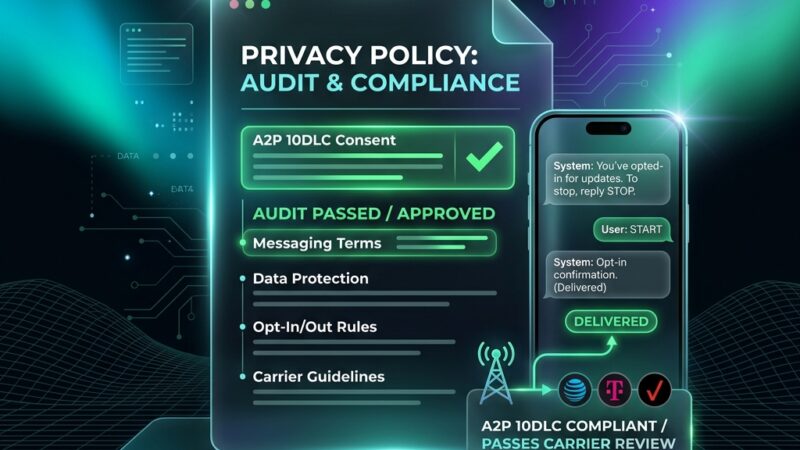
Why Your A2P 10DLC Campaign Was Rejected — And the Exact Privacy Policy Fix
Has your Twilio A2P 10DLC campaign been rejected? Learn the exact website privacy policy requirements and copy this compliance template to pass…