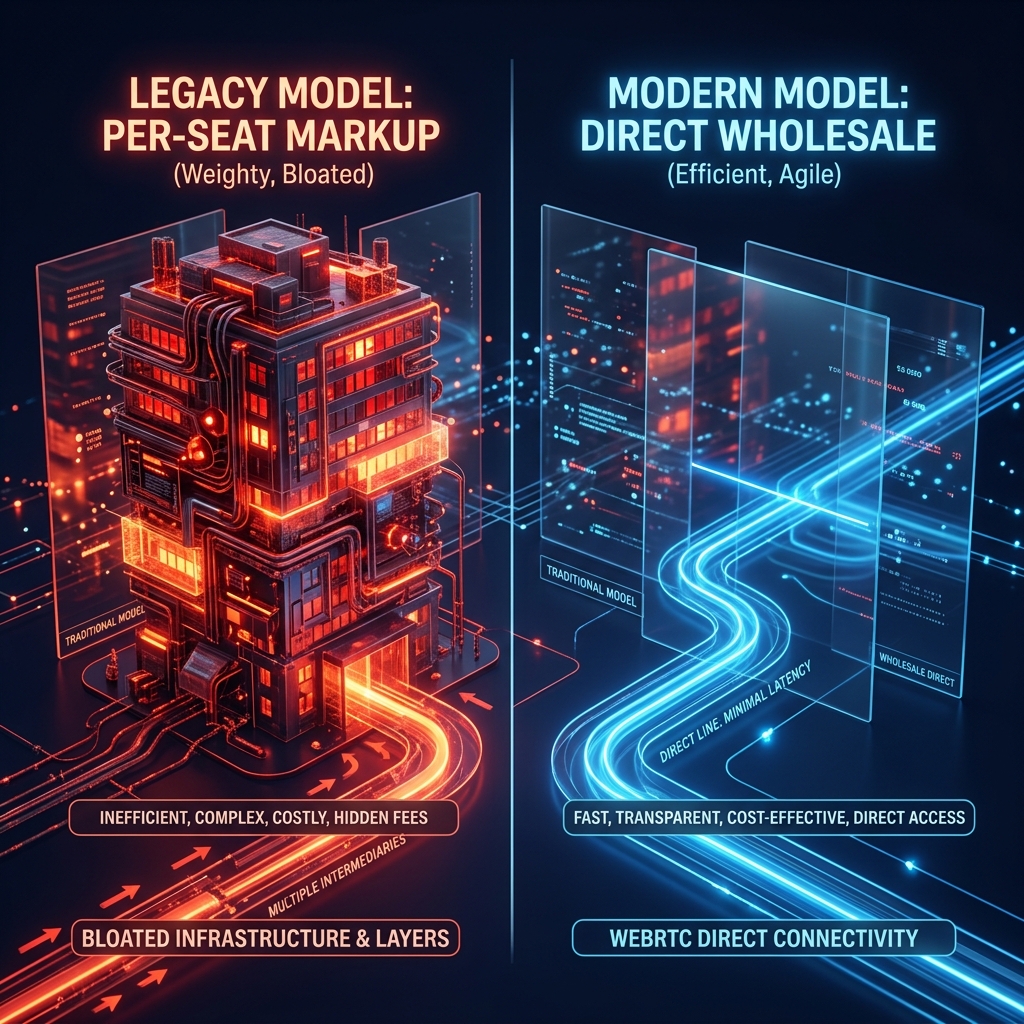
When business owners evaluate phone systems, they are typically presented with a choice between two different types of service: Unified Communications (UCaaS) providers like RingCentral, or programmable telecom APIs like Twilio.
Comparison articles almost always treat these as equivalent, competing software packages, comparing details like desktop app layouts, user counts, and customer service.
This comparison framing misses the core structural reality of modern telecommunications: RingCentral is not a direct alternative to Twilio. It is a middleman that resells carrier infrastructure at a massive markup.
By understanding the telecommunications supply chain and learning how to connect to the carrier layer directly, businesses can bypass per-seat markup packages entirely.
The Telecommunications Supply Chain Explained
To see where the markup is added, you must follow the path of a single phone call or text message through the modern telecom supply chain:
CODEBLOCK0
- The Tier-1 Carrier Networks: Companies like Verizon, AT&T, and Lumen own the physical fiber routes, cellular towers, and copper lines.
- The Wholesale Carrier API (Twilio): Twilio buys access to these physical networks in massive volumes. They convert raw telecom routing into developer-friendly software APIs, leasing numbers for $1.15 per month and routing calls for fractions of a cent.
- The UCaaS Middleman (RingCentral): RingCentral purchases numbers and routing capacity in bulk from wholesale networks. They package this infrastructure with a custom software client (for chats, dials, and video) and resell it using flat-rate Per-User, Per-Month (PUPM) pricing.
When you buy a seat license from a bundled VoIP vendor, you are not paying for expensive network routing. You are paying for a software user interface, administrative overhead, and the vendor’s marketing budget.
The Proof: Auditing the Middleman’s Gross Margins
This supply chain markup is not a theory. It is documented in the public financial filings of the companies themselves.
In their public SEC financial reports, major UCaaS providers routinely disclose gross margins of 55% to 65%. This means that for every dollar your business spends on a seat license, the provider spends only 35 to 45 cents on network infrastructure and hosting. The rest goes toward sales commissions, marketing campaigns, and investor dividends.
If your company has a phone bill of $1,000 per month, approximately $600 is paying for the middleman’s operational overhead—not the phone calls you made.
Cost Comparison: Wholesale Direct vs. Seat Licensing
To visualize the financial difference between direct wholesale access and per-seat retail licensing, review this billing comparison for a 15-user office consuming 6,000 total minutes of outbound calls and 2,000 minutes of inbound calls:
| Billing Category | RingCentral (Standard Seat @ $30/mo) | Direct Twilio + Blueprint Softphone |
|---|---|---|
| Fixed Software Cost | $450.00 / month (15 seats) | $4.99 / month (Flat software fee) |
| Line Costs (15 DIDs) | Included | $17.25 / month (15 lines @ $1.15) |
| Outbound Usage (6,000 Mins) | Included | $84.00 / month (6,000 mins @ $0.014) |
| Inbound Usage (2,000 Mins) | Included | $17.00 / month (2,000 mins @ $0.0085) |
| Total Monthly Telecom Bill | $450.00 / month | $123.24 / month |
| Effective Cost Reduction | Baseline | 72.6% Savings |
The direct carrier model strips out the seat license margins, leaving only the raw utility cost and a flat software fee. To see this markup deconstructed line-by-line, review our forensic VoIP invoice audit.
How to Access Wholesale Pricing Without Coding
Historically, connecting a business directly to Twilio’s wholesale pricing was impossible without an in-house engineering team to write TwiML scripts and manage WebRTC API keys.
Today, you can use a decoupled telecom architecture to bypass coding requirements:
Keep Your Numbers on Twilio: You lease your lines directly from Twilio, ensuring you retain 100% ownership and pay raw carrier rates.
Connect a Zero-Code Dialer: You connect a zero-code softphone interface like Blueprint Softphone. It authenticates with your Twilio account via secure API keys and automatically configures your lines, voicemail, and SMS routing.
This gives you a professional business communication app without paying per-seat middlemen markups.
The Bottom Line
RingCentral and similar per-seat VoIP providers are middlemen that buy wholesale carrier services and resell them at a significant markup. While their seat-based model historically appealed to non-technical buyers, the rise of decoupled zero-code softphones allows businesses to connect directly to wholesale carrier APIs like Twilio. This decoupled approach eliminates the middleman markup, slashes monthly telecom expenses by up to 70%, and gives your company complete ownership of its phone numbers and routing architecture.
Ready to Eliminate the Middleman Markup?
Blueprint Softphone provides a premium, zero-code frontend interface that connects your desktop directly to your Twilio account with 0% markup. Learn more about the decoupled architecture in our What is Twilio? guide, calculate your potential savings with our VoIP Seat ROI Calculator, or Get Started Free to connect your wholesale lines in under 10 minutes.
Brent Pope
Founder, Blueprint Softphone · 40+ years enterprise IT
Related Articles

The True Cost of a Twilio Phone Number: What You Actually Pay Per Month
Wondering what a Twilio phone number actually costs? Learn the exact carrier pricing breakdown for lines, calls, and SMS to calculate your…
The Decision-Maker’s Checklist: 12 Questions to Ask Before Signing a VoIP Contract
Expose hidden fees, per-seat markups, and number lock-in before signing. Use this 12-question checklist to audit VoIP vendor contracts.

What Happens to Your Phone Numbers When Your VoIP Provider Goes Bankrupt?
Is your business vulnerable to vendor insolvency? Learn how FCC number ownership rules work and why direct carrier leasing protects your lines.