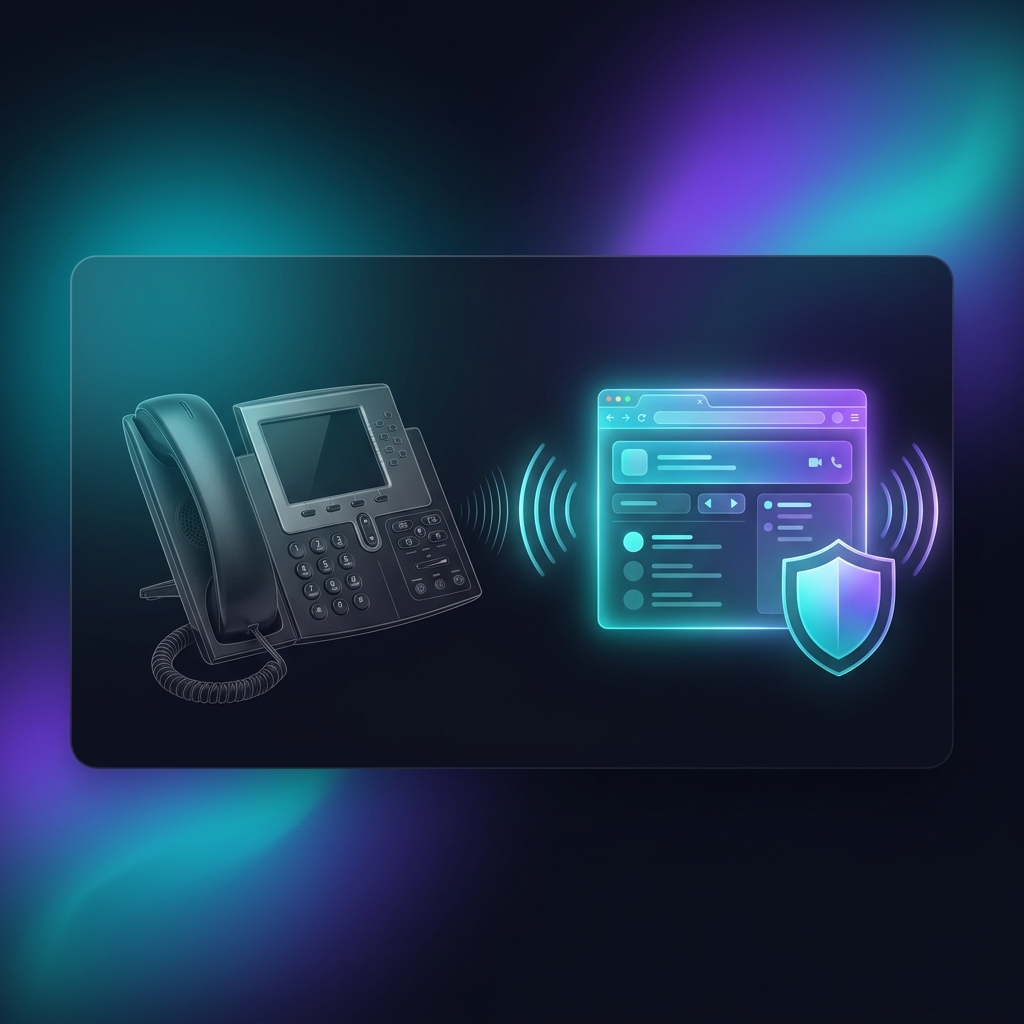
Are those plastic IP phones sitting on your office desks actually exposing your business to severe security breaches and unnecessary financial overhead? Yes, structurally. While legacy Session Initiation Protocol (SIP) desk phones have been the corporate standard for two decades, modern IT departments are actively decommissioning physical telephony hardware in favor of browser-native Web Real-Time Communication (WebRTC) software clients.
Shifting from physical SIP hardware to browser-embedded WebRTC is not just a cosmetic upgrade. It is a critical security and cost optimization: it eliminates the dangerous network vulnerabilities of raw SIP port routing, terminates the heavy hardware maintenance tax, and integrates your phone lines directly into your digital workspace.
Here is the architectural breakdown of why legacy SIP desk phones have become a liability, and why WebRTC is the modern enterprise standard.
The Security Threat of Legacy SIP: Exposing “SIP Scanning” Fraud
The most dangerous vulnerability of legacy physical desk phones is their reliance on raw SIP routing over port 5060. Physical IP phones operate as independent, standalone computers on your network. To receive and make calls, they must maintain open connections to a local PBX server or a cloud SIP gateway.
This open architecture makes legacy desk phones a prime target for automated hacker bots executing “SIP Scanning” attacks (often called brute-force toll fraud). Hackers scan massive public IP ranges looking for active devices listening on SIP ports (usually UDP/TCP 5060). Once a device is found, the bot executes rapid, brute-force dictionary attacks to crack the phone’s SIP credentials.
If successful, the consequences are immediate and severe:
International Toll Fraud: Hackers hijack the phone line to route high-volume, automated outbound calls to premium-rate international numbers they own, racking up tens of thousands of dollars in carrier charges in a single night.
Corporate Eavesdropping: Compromised SIP credentials allow malicious actors to register secondary silent listeners on your lines, intercepting corporate voice traffic.
Network Intrusion: An unpatched, physical desk phone connected directly to your office LAN serves as a compromised network endpoint, providing a bridgehead for hackers to lateral into other corporate databases.
Securing physical SIP phones requires complex firewall rules, specialized Session Border Controllers (SBCs), and isolating the phones on their own separate Virtual LANs (VLANs).
How WebRTC Solves Voice Security by Default
WebRTC (Web Real-Time Communication) resolves these security threats by completely removing physical hardware endpoints and standard SIP port routing from your office network. WebRTC is an open-source standard built directly into modern web browsers (Chrome, Edge, Safari, Firefox) that enables secure, real-time audio and video communications without requiring plugins or dedicated hardware.
Unlike legacy SIP, WebRTC enforces ironclad security by default through three architectural mechanisms:
- Mandatory End-to-End Encryption: WebRTC prohibits unencrypted media transmissions. All voice call channels are encrypted using SRTP (Secure Real-time Transport Protocol) for media streams and DTLS (Datagram Transport Layer Security) for cryptographic key exchanges. Your voice traffic is completely secure from interception, even when calling over public coffee-shop Wi-Fi.
- No Port 5060 Exposure: WebRTC does not listen on static public ports like UDP 5060. Instead, it establishes dynamic, secure, short-lived peer-to-peer connections negotiated through secure HTTPS web sockets. There is no static target for a SIP scanning bot to brute-force.
- Browser Sandbox Isolation: WebRTC operates entirely within the browser’s highly secure sandbox environment. A WebRTC softphone client has no direct access to your local machine’s operating system or network hardware, preventing a compromised line from ever serving as an entry point for corporate network intrusion.
SIP Desk Phone Hardware vs. WebRTC (The Direct Comparison)
When auditing your corporate telephony layer, WebRTC outperforms legacy SIP hardware across every operational dimension:
| Evaluation Dimension | Legacy Physical SIP Desk Phones | Browser-Native WebRTC Softphone |
|---|---|---|
| Primary Protocol | SIP over UDP/TCP Port 5060 | Secure WebSockets + DTLS / SRTP |
| Media Encryption | Optional (Rarely configured/complex) | Mandatory & Automatic (SRTP/DTLS) |
| Network Exposure | High (Target for brute-force toll fraud) | Zero (Runs inside browser sandbox) |
| Hardware Costs | $150 – $400 per physical desk phone | $0.00 (Uses employee’s existing computer) |
| Maintenance Tax | Heavy (PoE switches, cabling, firmware) | Zero (Auto-updated via standard browser) |
| Hybrid Portability | Extremely poor (Requires hardware VPNs) | Perfect (Works anywhere on any browser) |
| CRM Integration | Rigid (Requires proprietary middleware) | Seamless (Click-to-dial directly from webpage) |
The Invisible Cost of Physical Phones
The purchase price of a physical desk phone (typically $150 to $400 per unit) is only a fraction of its true Total Cost of Ownership (TCO). Business owners often overlook the heavy “invisible” infrastructure tax required to keep legacy physical phones operational:
Specialized Networking Hardware: Physical IP phones do not run on standard network ports. They require specialized Power-over-Ethernet (PoE) network switches to supply power, and dedicated office ethernet cabling drops at every single desk.
VLAN Configuration Surcharges: To prevent SIP scanning compromises from spreading, network administrators must configure and maintain complex Virtual LAN (VLAN) segmentations, partition routing tables, and install expensive hardware Session Border Controllers (SBCs).
Firmware Patching Overload: Just like a PC, physical desk phones run local operating systems (often stripped-down Linux builds) that suffer from continuous software vulnerabilities. IT teams must manually compile, test, and push firmware patches to hundreds of physical devices scattered across multiple offices.
By transitioning to a browser-native WebRTC client, your hardware, specialized switches, cabling drops, and firmware patching overhead instantly drop to zero.
How a Decoupled WebRTC Extension Works
Shifting to WebRTC does not mean you have to buy into a bloated, expensive corporate software seat license. The modern architectural fix is to decouple your communications frontend from your telecom carrier layer.
Traditional Unified Communications (UCaaS) providers force you into rigid, per-user monthly packages that bundle their software dialer with marked-up phone lines. To understand how flat-rate seat pricing inflates your bills, review our deep-dive analysis on the unlimited VoIP billing illusion.
Blueprint Softphone takes the opposite approach. Instead of acting as a bundled middleman, Blueprint provides a lightweight, highly secure WebRTC Chrome extension and web interface that connects directly to your own Twilio account.
This decoupled WebRTC architecture delivers:
Direct-to-Carrier Pricing: You pay Twilio’s raw wholesale rates ($1.15/month per number and ~$0.01/minute) directly, completely eliminating middleman markups.
Direct Level A Attestation: Your calls are digitally signed directly at the carrier level using your own registered business identity. This protects your outbound numbers from being flagged as a Spam Risk or Scam Likely by carrier network filters.
- No Code Required: You get the raw power, encryption, and wholesale pricing of Twilio’s direct WebRTC API without writing a single line of software code.
For a comprehensive explanation of how this direct carrier connection operates, review our educational What is Twilio? explainer.
The Bottom Line
Physical IP desk phones running legacy SIP are a major security vulnerability and a significant financial drain. Relying on raw port 5060 routing exposes your business network to automated SIP scanning and expensive international toll fraud. The modern corporate standard is to decommission physical telephony hardware in favor of browser-native WebRTC. WebRTC enforces mandatory end-to-end encryption by default, operates within a secure browser sandbox, and costs nothing in physical hardware or switch infrastructure. Decoupling your softphone dialer from your telephony account and connecting directly to a wholesale API carrier like Twilio delivers the highest level of WebRTC call security, absolute brand ownership, and massive cost savings.
Ready to Decommission Your Desk Phones?
Blueprint Softphone connects your desktop directly to your Twilio account via secure, encrypted WebRTC with 0% markup. Learn more about WebRTC browser benefits on our What is Twilio? guide, review our A2P 10DLC compliance checklist to secure text deliverability, or Get Started Free to connect your lines in under 10 minutes.
Brent Pope
Founder, Blueprint Softphone · 40+ years enterprise IT
Related Articles

The “Unlimited” VoIP Illusion: Why Mid-Market CFOs Are Paying a 1,000% Premium for Silent Seats
Learn why per-user monthly VoIP plans create an expensive billing illusion for mid-market enterprises. Discover how to decouple your softphone frontend from…
How to Build a Multi-Line Twilio Phone System in 10 Minutes (With Zero Coding)
Want to build a multi-line Twilio phone system but don't know how to code? Learn how to use Twilio without coding and…